

Strategic Plan
Table of Contents
Executive Summary
History
- Overview of RFHP
- Overview of FOR
NFHP and ACE Act Alignment
Why Reservoirs?
- Looking Beyond Primary Use
- Reservoirs as a Water Resource
- Exceptional Habitat Challenges
Our Approach
- Scope of Action
- Spatial Perspective
- Grassroots Foundation
- Unique Position as a FHP
- Science-Led Action and Learning
Our Goals and Principles
Appendix
- Habitat Assessment
- Partnership Structure and Governance
Executive Summary
Reservoirs are integral parts of the nation’s aquatic landscapes. Constructed to meet a variety of human needs, they occur throughout major river systems in the United States and affect, to varying degrees, habitat for fish and other aquatic species. At the same time, reservoirs are strongly influenced by the health of the watersheds that feed them and by the downstream waters affected by dam operations. Reservoirs, their associated watersheds, and their downstream flows therefore constitute interdependent, functioning systems. Effective conservation of these reservoir systems requires maintaining and improving ecological function and biological health while recognizing the water-supply, flood-risk, hydropower, irrigation, navigation, and recreational purposes for which reservoirs are managed.
Conservation of reservoir systems is also essential to quality of life for the American people. Reservoirs provide essential infrastructure services and are focal points for recreation, including recreational fishing, boating, wildlife viewing, and other outdoor activities. They contribute substantially to local and regional economies and provide habitat for innumerable species of fish and wildlife. The RFHP recognizes that durable fish habitat conservation must account for both ecological outcomes and the human communities that depend on healthy reservoir systems.
The Reservoir Fisheries Habitat Partnership (RFHP) is a national Fish Habitat Partnership that promotes and facilitates the protection, restoration, and enhancement of fish and aquatic habitat in reservoir systems through collaborative, voluntary, and science-based conservation. RFHP provides strategic coordination and technical capacity for reservoir-related habitat conservation while supporting local, state, tribal, regional, federal, private-sector, and other partners that implement conservation actions on the ground. RFHP emphasizes the integration of watershed conservation, in-reservoir habitat management, and downstream flow considerations to address root causes of habitat impairment and improve the function of whole reservoir systems.
The RFHP governance structure includes a national Steering Committee, four Regional Workgroups, staff and standing committees, and Friends of Reservoirs (FOR). The Steering Committee establishes partnership policy, conservation priorities, funding procedures, and performance expectations. Regional Workgroups help identify regional priorities, evaluate and support projects, and facilitate implementation and reporting. Friends of Reservoirs provides a complementary mechanism for stakeholder engagement, public participation, fundraising, communications, and support for on-the-ground conservation.
This Strategic Plan provides the RFHP roadmap for 2026–2031. It retains the partnership’s established reservoir-system focus and six strategic goals while updating their objectives, performance measures, and implementation framework to reflect the National Fish Habitat Action Plan: 3rd Edition (2026), the America’s Conservation Enhancement Reauthorization Act of 2024, and current National Conservation Priorities. The revised plan places greater emphasis on science-based prioritization, addressing root causes of habitat degradation, measurable conservation outcomes, recreational fishing and community benefits, collaboration with other Fish Habitat Partnerships, and transparent reporting of results. The plan is intended to remain a living document and will be updated as NFHP priorities, science, policy, funding, and partnership needs evolve.
History
The Reservoir Fisheries Habitat Partnership (RFHP; www.friendsofreservoirs.org) is one of the recognized Fish Habitat Partnerships (FHPs) of the National Fish Habitat Partnership (NFHP; www.fishhabitat.org). It evolved from several years of discussions, meetings, and collaboration among state and federal agencies, conservation organizations, private-sector businesses, and committed individuals. A common interest in the health of the nation’s reservoir systems brought people of differing outlooks and wide-ranging locales together around a shared conservation purpose. From its first meeting in Atlanta, Georgia, in June 2007, through subsequent meetings and planning efforts, the partnership articulated a vision and created a strategic framework to protect, restore, and enhance fish and aquatic communities within reservoirs and their watersheds. RFHP was recognized by the NFHP Board as a Fish Habitat Partnership in October 2009 and continues its work within the national framework reaffirmed by the America’s Conservation Enhancement Reauthorization Act of 2024 (Public Law 118-198).
Shared scientific values and a common understanding of the importance of reservoirs structured the dialogue that initiated and developed the partnership. In particular, three core facts guided the formation of the partnership. First, reservoirs are ubiquitous; found in almost every major river system in the United States, they number in the tens of thousands. They have often dramatically altered the ecological functions and processes upon which aquatic species rely. Two, reservoirs are persistent, albeit human-made, features of the natural landscape. Over time a small number will be removed, but across the lifespan of multiple human generations the majority of large reservoirs will remain intact. Three, reservoirs provide important services to people and their communities, from drinking water to flood risk reduction, to navigation, to power generation, to fishing and boating and other forms of recreation. Reservoirs can add to the quality of human life under thoughtful stewardship.
The RFHP is committed to advancing the quality of life for all species. We believe that reservoirs in conjunction with their downstream and watershed components – what we term the reservoir system – can, through considered and strategic conservation, provide for the needs of both human and aquatic communities. Yet, the barriers to do so – all of which are related to how we govern and make decisions about our reservoirs – are substantial and daunting. For example:
- Reservoir responsibilities are divided among dozens of agencies and across multiple jurisdictions, fragmenting reservoir management and often disconnecting that management from the health of downstream waters and the upstream land uses and flows that ultimately determine their longevity and health.
- Data that are essential to conservation of fish habitat in reservoirs, downstream, and in watershed tributaries are scattered and incomplete, challenging management agencies in need of sound data to implement best management practices.
- Communication and networking among reservoir managers nationwide need to be improved to facilitate the sharing of information and the development and testing of best management practices and new restoration technologies.
- Reservoirs are key habitat types, yet information regarding them is either missing from or not integrated into our national aquatic landscape models, plans, and conservation strategies.
- Public awareness and understanding of the role of reservoirs in watershed health, and the importance of healthy reservoir systems to overall human well-being, is insufficient and incomplete, impeding the progress of effective public policy needed to address the many issues challenging reservoirs and their watersheds.
Institutional barriers to reservoir management are not the only threat to quality of life: environmental challenges are multi-faceted and increasing. Quality of life for aquatic organisms and people is threatened when:
- Ailing watersheds deliver water to reservoirs at the wrong time and in the wrong amounts.
- Bad watershed management practices accumulate unnatural nutrient loads and sediments in reservoirs and downstream waters.
- Human actions result in the spread of invasive aquatic species throughout reservoir systems.
- Timing and quantities of downstream flows are disconnected from the needs of downstream human and aquatic communities.
- Reservoirs age, fish habitat structures disappear, and prey availability declines.
- Human development erodes or directly destroys riparian and nearshore aquatic habitat along reservoir shorelines.
- Ecological functions essential to aquatic life and its habitat falter under the cumulative burden of all of these transformations.
The RFHP is a unified and collaborative response to the governance barriers and environmental challenges that threaten the quality of our lives.
RFHP leadership felt that to best meet the goal of ensuring healthy reservoir systems for future generations two separate but intricately connected organizational units were needed. The target audience of The Reservoir Fisheries Habitat Partnership, as outlined previously in this document, is the professional natural resource manager and conservationist. The focus of RFHP is the science behind reservoir habitat restoration efforts and communicating among professional resource managers how best to meet those challenges.
To further the development of collaborative conservation of reservoir fisheries, RFHP leadership recognized the need to have in place a financial support mechanism, independent of government funding, to facilitate collaborative actions. The Friends of Reservoirs (FOR) a 501(c) (3) corporation, was founded in August 2010 to provide a mechanism to procure non-governmental funding for reservoir fisheries habitat restoration efforts and create a formal partnership framework. Friends of Reservoirs is intended to be the financial and outreach arm of the RFHP. Its target audience is nonprofessional conservation and angler groups, reservoir-user groups, corporations, non-profits and policy-makers.
The Mission and Vision of each entity differ to some degree and are outlined below, with greater detail provided in the Appendix.
Reservoir Fish Habitat Partnership
Mission
The Reservoir Fisheries Habitat Partnership is a national partnership that promotes and facilitates the conservation of habitat for fish and other aquatic species in reservoir systems through collaborative actions that contribute to:
- the ecological health and function of reservoirs and their associated waters and watersheds;
- healthy reservoir systems, critical to providing water in sufficient quantity and quality to support humans and their communities, and the aquatic life that thrives within their waters.
- the restoration, protection and enhancement of fish and other aquatic species and communities;
- the sustainability and enhancement of reservoir fisheries;
- public awareness of the conservation issues and challenges confronting reservoirs and associated waters and watershed management in the 21st Century;
- networking among professional fishery managers and Friends of Reservoirs (FOR) partners to provide best management practices, expertise, and guidance on project implementation; and
- the quality of life of the American people through healthy reservoir systems, sustainable fisheries, and meaningful opportunities for recreation and community participation.
Vision
Clean water and healthy aquatic habitat in reservoirs and their connected waterways are not optional for our nation’s future. Healthy reservoir systems are critical if we are to provide water in sufficient quantity and quality to support humans and their communities, and the aquatic life that thrives within their waters. We envision a future of healthy reservoir systems that are sustained by collaborative action to benefit (1) people, their communities, and their economies and (2) fish and other aquatic species, and their communities, for future generations. It is a future where:
- Our partnership leads in identifying and implementing, through collaborative partnerships, priority habitat projects within reservoirs and their associated waters to protect, restore, and enhance important fisheries;
- Sustainable management of reservoir systems is supported by broad public participation based on dialogue, collaboration, and consensus building;
- Partners who have not traditionally worked together in addressing reservoirs and connected lands and waters will now plan, fund, and support actions to protect aquatic habitat in those systems;
- Reservoirs are managed as part of encompassing natural systems that include both upstream and downstream flow components, and terrestrial areas impacting or influenced by those components;
- The value of healthy and sustainable reservoir systems are understood and appreciated by the millions of Americans who use them and the elected officials who determine the policies that govern them;
- Our partnership is instrumental in motivating and coalescing reservoir stakeholder groups and other conservation partnerships to support and implement actions that address priority aquatic habitat needs in reservoirs, downstream waters, and associated watersheds;
- Sustainable economic development is predominant and contributes toward the conservation of healthy reservoir systems nationwide;
- Adequate information systems and communication networks exist to support the development of best management practices and appropriate technologies to support the conservation of fish habitat in reservoir systems;
- Our partnership can scientifically contribute to informed policy decisions on the management of reservoir systems and their future modification;
- Recreational uses of reservoir systems are expanded, made more available to all Americans, and connected through volunteerism to the conservation of those systems;
- Regulatory agencies and ownership jurisdictions within reservoir systems cooperate to establish seamless management and conservation.
Friends of Reservoirs
Mission
Friends of Reservoirs raises awareness about the importance of ecologically healthy reservoirs in the United States. This is critical because, in addition to fishing and other recreational use, reservoirs provide municipal water supply, flood control, hydropower, irrigation, and a number of economic benefits to local communities. We identify and implement priority habitat projects within reservoirs and their associated waters to protect, restore, and enhance important fisheries.
Vision
We envision a future of healthy reservoir systems to maintain fisheries and fish habitats, while preserving recreational and economic benefits for every American and future generations.
NFHP and ACE Act Alignment
The 2026 National Fish Habitat Action Plan establishes four long term ecological goals: protect and maintain intact and healthy aquatic systems; prevent further degradation of fish habitats that have been adversely affected; reverse declines in the quality and quantity of aquatic habitats; and increase the quality and quantity of fish habitats that support a broad natural diversity of fish and other aquatic species.
RFHP contributes to all four NFHP goals through its reservoir-system focus. RFHP will emphasize protection of functioning reservoir habitats, prevention of further degradation, restoration of impaired habitat and ecological processes, and enhancement of habitat conditions that support diverse and sustainable fish and aquatic communities.
The America’s Conservation Enhancement Reauthorization Act of 2024 (Public Law 118-198) re-codified the national fish habitat framework. The ACE Act framework reinforces the importance of National Conservation Priorities, project development and selection, partnerships, measurable habitat benefits, public access and recreational fishing opportunities, and reporting of conservation accomplishments.
Back to top
Why Reservoirs?
Reservoirs are human modifications of watershed systems resulting from the damming or impounding of a free-flowing stream or river, and are designed to deliver water, navigation, hydropower, flood risk reduction, and other services to communities. These impoundments alter and transform natural streams or river systems, affecting (even eliminating) resident populations of aquatic species and the ecological functions and habitat upon which those populations depend (IUCN, 1997). In time, reservoir functions are affected by land uses in the watershed that affect, in turn, water quantity and quality.
These cumulative impairments – whether caused by reservoirs or evidenced in their health and the health of their watersheds – must be properly measured and addressed to protect, restore, and enhance habitat for fish and other aquatic species. In some cases, the best course of action is to remove reservoirs from watershed systems, especially when science and social opinions concur. In most other cases, removal of reservoirs is not an option; they are, in effect, virtually permanent, naturalized components of their watersheds, and the impairments associated with them must be addressed both within and beyond their spatial boundaries.
Most reservoirs are built for one or more of four primary uses: hydropower, flood risk reduction, irrigation water, or as a drinking-water resource. Once constructed, these water bodies are also used for wildlife and fisheries habitat, aquaculture, recreation, transportation, land development, and to provide aesthetic values for people. Research suggests that reservoirs also function as sites for carbon sequestration (Dean and Gorham, 1998; Einsele and others, 2001) and, if properly managed, can be used to offset local and even regional carbon emissions, reducing the carbon footprint of the communities surrounding them. Traditionally, the four primary reservoir uses and their management take precedent over secondary and competing uses, constraining other conservation objectives – including fish habitat conservation. As a result, management of fisheries habitat in reservoirs is challenged: it must be pursued and optimized consistent with delivery of the primary uses. A greater knowledge of the true value of reservoir fisheries may, in time, alter the balance of uses.
Back to top
Looking Beyond Primary Use
Water that is stored in reservoirs and regulated by dams provides a number of essential benefits to society, including water supply (agricultural and domestic), navigation, hydroelectric power production, flood risk reduction, outdoor recreation, sport fishing, tourism, fish and wildlife habitat, and an aesthetically pleasing setting. Water from reservoirs is used to improve crop yields, provide drinking water, generate renewable and environmentally clean energy, and offer drought and flood mitigation. These reservoir services help sustain our economy and our civilization.
For example, reservoirs enhance the economic growth of both local and regional communities that lie adjacent to them or in their general proximity. The population growth and quality of life in northwest Arkansas, home of WalMart, Tyson Foods, and other major industries, would not be the same without the attraction and benefits of Beaver Lake, a U.S. Army Corps of Engineers hydroelectric power generation, flood-risk-reduction, and water-supply reservoir. The same is true for the communities between and including Branson and Springfield, Missouri. There, Table Rock Lake - the reservoir immediately downstream from Beaver Lake – adds enormously to the livability and attractiveness of those towns and cities. Elsewhere, the same story is repeated: reservoirs enrich the quality of life for many Americans across the nation.
Sportfishing alone brings in billions of dollars per year into the U.S. economy. The American Sportfishing Association analyzed the economic effect of reservoirs in 2006 (American Sportfishing Association, 2008) and found that America’s nearly 40 million anglers spent over $45 billion per year on fishing equipment, transportation, lodging, and other expenses, much of it directly attributable to reservoirs. These expenditures, in turn, generated $125 billion annually for the national economy and supported over 1 million jobs – jobs that generated $34 billion in yearly wages and $16 billion in annual taxes. Of fishing’s total economic impact, about 70 percent is attributable to freshwater activities (not including the Great Lakes), and of that percentage the majority is attributable to reservoir sportfishing. Significantly, almost $1.2 billion of annual sportfishing revenue has been reinvested into aquatic conservation and protection programs in recent years. Today, these dollars are the primary source of funding to improve fish habitat, ensure adequate public access to waterways, and provide environmental education.
Sportfishing enthusiasts are not the only ones to benefit from reservoir-based recreation. Over 75 million Americans, including 47 million bird watchers, rely on reservoirs to provide an array of non-fishing, outdoor activities – extending from picnics to boating to trail hiking to nature photography and viewing. In their pursuit of wildlife viewing, alone, Americans spend nearly $45 billion a year, matching the expenditures of anglers – and, according to projections, likely to exceed those expenditures in the future. In many ways, reservoirs are the nation’s multi-use gateways to nature and wildlife for a growing number of Americans whose exposure to the outdoors is increasingly constrained by population growth, development, and urbanization.
Economics elevates the importance of reservoirs, but it does not explain the ecological significance of reservoirs to the management of America’s fisheries. As unnatural intrusions into natural streams and rivers, reservoirs transform water flows, vegetation, structure, sedimentation rates, oxygen levels, temperature stratification, and other physical and biological parameters that are essential to healthy fish habitat. As such, they affect resident fish populations, alter downstream aquatic environments and, in turn, are affected by the health of the watershed above, making them indisputable features of the human and natural landscape. Reservoirs shape and are shaped by the respective watershed in which each of them exists.
Ailing reservoirs usually mean ailing watersheds; causatively, the two go hand-in-hand, almost always inseparable. In contrast, a healthy reservoir – the principal goal of this partnership – implies a healthy watershed, the product of which is a healthy reservoir system. For our partnership, healthy reservoir systems mean (1) downstream flows are adequate to sustain below-dam native and naturalized flora and fauna; (2) watersheds above the reservoir yield flows and water-borne materials (e.g., sediments and woody debris) that are appropriate in timing, quantity, and quality to sustain fish and other aquatic communities; and (3) aquatic habitat within the impoundment supports rich and diverse aquatic communities. Reservoirs are the metaphorical canary in the labyrinth of waterways that comprise reservoir systems; they can be ignored only at great peril to the nation’s freshwater fish and other aquatic life.
Back to top
Reservoirs as a Water Resource
Renewable water resources are becoming increasingly valuable as human population continues to increase and shifts to concentrated urban and metropolitan areas. In 2007, the world population moved from a rural to an urban majority. The U.S. Census Bureau projects that world population will grow from 6.1 billion in 2000 to 9.4 billion by 2050 – a 50 percent increase. The demand for abundant, clean water will accelerate in tandem with population growth and urban demands. As a result, the need for large and sustainable potable water-supply sources will continue to grow, stressing our existing multi-purpose reservoir systems, and prompting either the development of new reservoirs or inter-basin transfer of water from one reservoir to another. Water stored in reservoirs will increasingly be the primary source to supply and meet mounting human demands, while satisfying the habitat needs of fish and other aquatic organisms. Given the financial and environmental costs of constructing new reservoirs, it is particularly critical that our existing reservoirs and their supplying watersheds remain healthy, and that those impoundments remain clean and at full capacity to sustain multiple and often conflicting purposes.
Additionally, as population centers become more concentrated around reservoirs and more dependent on them for their water-supply, recreation, and leisure benefits, proper management of these reservoirs and their watersheds will be critical to not only sustain these benefits but to meet downstream resource needs, including healthy habitat for fish and other aquatic organisms. Inter-basin transfer of water between reservoirs will be required to deliver water to areas of greatest need. Mixing waters of different qualities and contents will have its problems, including the transfer of exotic species, pathogens and viruses, contaminants, and other physical and biotic components. Maintaining healthy reservoirs and properly functioning watersheds is critical today; but it will become even more important as a social priority in the future, one with broad economic and ecological ramifications.
Increasing average global air temperature causes wider swings in regional air temperatures and mild to dramatic variations in precipitation amounts and long-term rainfall trends (Bates et al., 2008). Excessive precipitation in some areas of the U.S. is expected to amplify the intensity and frequency of flooding. Enlarging reservoir storage capacities, creating new reservoirs, or making room for floodwaters in reservoirs are a few of the ways in which reservoirs will become tremendously important. In other areas of the country, winters will become warmer, shorter, and produce less snow influencing the amount and timing of reservoir water storage. Excessive heatwaves and prolonged droughts will also exhaust water storage at an accelerated rate. Better planning, use, and conservation of stored water (for irrigation, hydropower, municipal, etc.) will help reduce the vulnerability of reservoirs and their fisheries’ to threats in water supply.
Reservoirs can combat some of the effects of climate extremes through their capacity to store usable water and ability to diminish flood risks (DHI, 2016). Additionally, deep-water releases from dams become increasingly valuable by maintaining coldwater relief to downstream fish communities (Cummings et al. 2013). Reservoirs also become repositories of greenhouse gases (Dean and Gorham, 1998; Einsele et al., 2001) where large amounts of carbon dioxide can be removed from the atmosphere and fixed by reservoir phytoplankton and littoral vegetation. Upon decomposition of organic matter, carbon dioxide and methane become trapped in the sediments (Palau and Alonso, 2008).
Back to top
Exceptional Habitat Challenges
When a river is impounded, the river valley becomes submerged beneath the surface of the reservoir pool. Nutrients and organic matter in the soil and from the decomposition of pre-existing terrestrial vegetation provide an abundant energy source for primary production (Kimmel and Groeger, 1986). This energy moves through the food chain allowing for rapid and luxuriant growth of phyto- and zooplankton and benthic invertebrates, the food source of prey species, which in turn become the food source for piscivorous fish. The submerged trees and shrubs and other landscape features provide habitat for spawning and protection from predators for eggs and larval fish. This classic habitat progression that follows impoundment is called the “trophic upsurge.” After five to twenty years, the initial biomass and production of fish declines in what is called the “trophic decline.” Much of the original habitat structure decomposes and is eliminated, or it is covered up with silt and sediments. The reservoir eventually reaches an equilibrium level of low productivity and limited success for sport fishing.
Reservoirs face many challenges pertaining to healthy fish habitat. These challenges can be grouped into seven habitat impairment categories, each of which corresponds to habitat improvement objectives addressed in the RFHP conservation strategy and ecosystem processes detailed in the NFHP Science and Data Committee Framework for Assessing the Nation’s Fish Habitat.
- Riparian, Shoreline, and Littoral Zone Hydrologic Conditions (Material Recruitment, Hydrology, and Bottom Form in the NFHP framework document). Water levels in reservoirs often fluctuate significantly in frequency and can vary widely in height – the outcome of weather extremes, irrigation schedules, watershed condition, and power generation. Regardless of the cause, fluctuating water levels affect the spatial positions, temporal extent, and function of the wetted riparian, shoreline, and littoral zones. In the shallow littoral zone, gravel beds occur in the top few meters where wave action keeps the bottom free of silt. Persistent drawdown below this level minimizes vegetation and alters bottom structure. Soil type, wave action, shoreline erosion, and high turbidity further impact littoral zone plant and bottom substrate. Less vegetation and altered bottom substrate reduces spawning habitat (and spawning success) for nest building fish or any fish in which the eggs attach to a particular substrate (O’Brien, 1990). Increasing water levels in the spring through watershed restoration or reservoir pool management may improve spawning success by inundating gravel areas and terrestrial vegetation. Degradation of riparian and shoreline habitat caused by persistent water fluctuations is incremental and cumulative (Jennings et al., 1999). Loss of riparian buffer strips and associated erosion of shoreline zones impact vegetation and other physical structure, diminishing spawning habitat and nursery and feeding areas and increasing the vulnerability of larval fish – highly dependent on vegetation for protective cover – to predators (O’Brien, 1990). Poor development or loss of riparian zones, and diminishment of the functional role they would otherwise play in filtering runoff water, may also lead to turbidity and nutrient levels above that expected if natural process were intact in reservoirs. This, in turn, may further prevent establishment of macrophytes, causing a shift toward algal-based primary production. Severe water fluctuations also impact angler access, habitat connectivity, downstream flow, and other key habitat issues.
- Watershed Connectivity. Irregular water level fluctuations affect the hydrologic connectivity reservoirs have with their watersheds, impacting (1) resident and fluvial reservoir fish populations and (2) diadromous and fluvial populations in impounded rivers. The life history of many reservoir fish species requires access to backwater areas and other littoral habitats, as well as upstream and downstream rivers and streams. For some species, these areas are critical to spawning and recruitment. Reservoir system operations related to flood risk reduction, water supply, and hydropower generation can impact availability of these key habitats. Sometimes, multiple reservoirs are located on a major river system, forming a chain or cascade of reservoirs. Under these circumstances, watershed connectivity is almost totally absent in downstream reservoirs where inflows are controlled by upstream dams. These controlled flows, in turn, create substantial barriers to fish passage and can severely impact loading of materials such as sediment, nutrients, and organic matter. Reductions in these functions impact the energy flow and food web of the receiving reservoir (Ward and Stanford, 1983), further impacting fish habitat. Other fish passage barriers such as low head dams, concrete channels, and poorly designed culverts further fragment these systems, reducing available habitat. Additionally, the thermal regime of the inflow will be altered if in close proximity to the upstream bottom-release reservoir. No less important, human activities and land uses within the watershed can accelerate erosion, and result in sedimentation that creates further barriers to fish passage.
- Water Quality. The health of a reservoir system is strongly influenced by the quality of water that enters and flows through it. Land use practices, point and non-point source pollution, nutrient loading, internal reservoir processes and dam releases all influence water quality in a reservoir system. Water temperature and dissolved oxygen dynamics in reservoirs follow patterns similar to those in natural lakes as described in the limnology texts, but differ in many aspects as a result of the retention times and chemical release dynamics of each unique reservoir system (Cole and Hannan, 1990). Turbidity and nutrient levels can impact the volume of hypoxic water in a reservoir which, in turn, limits the habitat available to fish. These same parameters can also influence the type and amount of aquatic macrophytes present in the reservoir system as well as the degree of impact of nuisance plant species. Point and non-point source pollution, and the pathogens contained within, can lead to fish and human health advisories. Nutrient enrichment can also produce toxic or harmful algal blooms that detract from the economic and social benefits that reservoir systems provide. However, when considering fish habitat, it is important to note that reducing nutrient inputs below historical levels can lead to trophic decline – a depression in the reservoir feeding base and a subsequent reduction in fish production (Ney, 1996; Maceina and Bayne, 2001). Maintaining systems within the bounds of their natural variations is critical (NFHP framework document).Dam operations impact water quality upstream and downstream. Bottom release withdrawal at the dam accelerates the development of the anoxic zone in the hypolimnion, by influencing water temperature and the volume of the hypolimnion (the more rapidly that water is discharged downstream, the greater is the anoxic zone near the dam). The cold, oxygenated water that is mined out of the hypolimnion is replaced by warmer, less oxygenated water from above. All of this will determine the size and extent of the thermal refuge in the reservoir upstream of the dam during and throughout the stratification season. Dam operations will also affect habitat conditions downstream in the tailwater because of changes in temperature, dissolved oxygen, and flow regimes, all influencing fish and invertebrate assemblages.
- Sediment Inputs (Material Recruitment in the NFHP framework document). Longitudinal connectivity in river systems is disrupted by transformation of rivers into reservoir cascades (Ward and Stanford, 1983; Miranda et al., 2008). As a result, natural sediment flows are disrupted both in the river system and in each reservoir sub-system. In many cases, sediments may be trapped in the upper reservoir and not distributed naturally downstream, leading to a loss of habitat or creating sediment hungry systems that degrade the bed elevations of tailwater areas. Sediment deficits typically contribute to incision, downcutting, armoring, and narrowing of channels in areas downstream from dams. Accelerated sediment yields resulting from watershed land use practices not only lead to excessive sedimentation in the upper reservoir, but can alter water flows in reservoir tributaries. Such sediments often carry with them nutrients, pathogens, metals, and other inorganic and organic contaminants impacting the water quality of the receiving reservoir.
- Physical Habitat (Bottom Form and Living Habitat in the NFHP framework document). Physical habitat may include gravel/boulder substrates, submergent or emergent aquatic vegetation, large woody debris or other forms of structural habitat, all of which are critical to some aspect of a fish species’ life history. Preferred habitat types will vary among species, but in all cases they will play some role in spawning, recruitment, feeding, staging, and other activities. Overall, physical habitat can help reduce near shore erosion and sedimentation, and provide anglers with essential fishing structure. Many southern reservoirs are lacking complex physical habitat due to basin clearing during construction (Jenkins, 1970). Other reservoirs may be lacking this type of habitat due to residential development in the riparian zone (Barwick, 2004). Ultimately, as reservoirs age, some forms of physical habitat will degrade while others may proliferate (e.g., native and/or invasive aquatic vegetation).
- Nuisance Species (Food Webs and Energy Flows in the NFHP framework document). The presence of invasive nuisance species can negatively impact reservoir ecosystems, degrade reservoir infrastructure and present other problems to reservoir managers. When nuisance species become prevalent in a reservoir, the native species tend to suffer. In the case of fish and other aquatic organisms, the nuisance species may displace native and naturalized species through predation, competition, or their ability to tolerate greater variations in reservoir conditions, often caused by existing reservoir system habitat issues. Nuisance aquatic plant species may displace native species through crowding and shading. Dense populations of nuisance aquatic macrophytes can provide greater protection, and therefore survivorship, of prey species, reducing sport fish production (O’Brien, 1990). Nuisance aquatic and riparian species not only pose a threat to native species, but they may reduce the recreational quality of a reservoir system and affect downstream resources. Quagga and zebra mussels, for example, broadly impact dam functions, including power and water delivery. This, in turn, can impact recreation through boating and other reservoir-use restrictions.
- Inconsistent Water Supply. Habitat degradation resulting from variable water supply and related weather is expected to negatively influence aquatic life, recreational fishing, and other water-based recreational activities (Jones et al., 2013; NWF, 2013; Boyer et al., 2017). This will further challenge fisheries management in multiple-use reservoirs (NWF, 2013; DHI, 2016) and with fish species occupying the edge of their tolerance ranges (NWF, 2013). Critical changes are likely to occur with the physical and chemical make-up of reservoirs resulting in larger and more frequent water level fluctuations, warmer water temperatures, higher nutrient loading, higher trophic state, stronger stratification, and greater turbidity among other diminished environmental conditions. This may require shifting water management strategies to accommodate for the habitat needs of a different aquatic community. For example, with an expected warming trend, reservoirs that have historically maintained coldwater species (e.g., salmonids) may begin to experience their decline due to water conditions that are more suitable for supporting either cool- or warmwater fish assemblages (see NWF, 2013). Moreover, coolwater and warmwater species are typically reliant on in-reservoir spawning and rearing habitats, hence managing for specific water regimes are essential in maintaining connectivity to these habitats (Miranda, 2017). Aquatic invasive species also have immense abilities to expand rapidly, dominate in unoccupied habitats, and displace other organisms and, therefore, prevention, early detection, elimination, and containment become extremely important for protecting an existing fish community, fish habitat, recreational access, or other public uses in reservoirs (Magnuson, 2007; Burgiel and Muir, 2010; NWF, 2013).One of the critical impacts predicted in reservoirs from variable temperatures and precipitation is the degradation of water quality towards eutrophication, which is related to increased warming, reservoir location in the basin, lower water levels, or greater input of nutrients/organic matter (Vincent, 2009; DHI, 2016; Hayes et al. 2017). With this, there will be even larger contributions of greenhouse gas emissions resulting from the decomposition of large amounts of autochthonous and allochthonous organic matter into carbon dioxide and methane that become readily available under anaerobic conditions (Palau and Alonso, 2008; Vincent, 2009). Positive management actions can include hypolimnetic aeration promoting mixing and the elimination of oxygen-depleted strata or through the eradication of benthivorous fishes such as common carp to prevent disturbing the bottom (see Hayes et al. 2017). Intensified flooding or watershed runoff events are expected to increase the influx of organic matter and nutrients as well. These additions will contribute more to the store of carbon dioxide, methane, and nitrous oxide in reservoirs (see Palau and Alonso, 2008; Vincent, 2009, Adamczyk and Shurin, 2015). Proper watershed management can protect vulnerable upland habitats affected by heavy or prolonged rain events (DHI, 2016) and reduce loading of nutrients, organic matter, and other pollutants in reservoirs (see Palau and Alonso, 2008). Promoting healthier water quality, preventing eutrophication, and consciously managing water levels during times of wild climate swings will also provide a healthier environment and greater spatial habitat for fishes in reservoirs (NWF, 2013; Miranda, 2017).
Collectively, these threats are systemic, affecting every impounded river and associated watershed in the nation, from the coastal and piedmont region of the south to the prairies of the Midwest to the Rocky Mountains and intermountain West to the far western Pacific ranges and valleys to the distant landmasses in Alaska and the Pacific Islands. Our partnership is, by necessity, national in scope and will be active wherever there are willing partners. It embraces the commonalities that unite reservoirs nationwide – from physically similar systems to shared environmental threats and habitat issues to the pressing challenges presented by complex and overlapping jurisdictions, varied and impassioned human uses, and national security and public policy themes. All of these factors bind U.S. reservoirs together as a single natural resource of great national importance.
Back to top
Our Approach
Scope of Action
The RFHP includes in its scope of action all manmade bodies of water formed by the impoundment of otherwise free-flowing rivers and streams and that are both accessible to the public and that support, or have the potential to support, a sport fishery. We include in this scope of action (1) those sections of downstream tailwaters, and adjacent wetlands and riparian areas that are affected measurably by dam releases and (2) the upstream headwaters, tributaries, and lands of the watershed whose flows and uses demonstrably impact the quality and quantity of water entering reservoirs.
We limit the scope of our action within reservoir systems in two important ways. One, the partnership will only address reservoirs that are accessible to the public. Reservoirs that are closed to public access by virtue of ownership or regulation are unlikely to afford opportunities for partnered conservation action. Moreover, public access is a principle that underscores this partnership’s commitment to citizen participation in the conservation of reservoir resources. Two, the partnership excludes from its scope of action those reservoirs that do not support and do not have the potential to support a sport fishery. We are committed as a partnership to conserve fish habitat in order to protect, restore, and enhance fish and other aquatic populations. We are also committed to quality sport fish recreation and sustainable fisheries in the reservoirs we seek to protect, or return to healthy status. Reservoirs that do not or cannot support a sport fishery fall outside the scope of our conservation strategy.
Although our operational definition of treatable reservoirs narrows our scope of action, the pool of reservoirs (and their associated tailwaters and watersheds) available to us for fish habitat conservation is substantial, covering every state and major physiographic region of the U.S. The thousands of reservoirs currently in our inventory span and include the full typology of reservoir types found in this country.
Back to top
Spatial Perspective
Although our partnership is national in scope, cutting across the human-made boundaries that divide our nation into political jurisdictions, natural boundaries exist that are critical to structuring our partnership, determining who we are, what we do, and how we do it. Watershed boundaries are pre-eminent in our conservation strategy. Our immediate target is the health of reservoirs and associated fisheries, but our long-term focus is on the health of the waters that feed, reside in, and flow from those impoundments. We will address both by collecting management information on reservoir systems and developing improved management practices based upon it.
Reservoir health is a direct reflection of the health of the watershed in which it is located. We know that we can best protect, restore, and enhance fish and aquatic communities when our habitat conservation strategies and actions contribute to the ecological integrity and function of the watersheds in which our reservoirs reside. Structurally-intact and well-functioning watersheds yield cascading benefits, from healthier reservoirs to healthy fish habitat to a healthful day of fishing – a facet among many to the quality of life we seek as a nation.
Partnership boundaries are also vital to our purpose. They may be small or large, focused on a species or a geographic area. However constituted, they demarcate the places where those partnerships practice their conservation. For the RFHP this is critical: to achieve our reservoir-based mission we must work with other partnerships in the places where they work. Their boundaries create opportunities for us – opportunities to work collaboratively with them in their areas of operation and expertise to implement fish habitat conservation that coincides with our strategic reservoir priorities. Reservoirs, and the waters that feed into and flow from them, cross innumerable ownership jurisdictions and engage multiple agencies in their management and regulation. No single ownership or government entity has the authority or the capacity to manage reservoirs as parts of watershed systems. Moreover, our capability to conserve habitat that is vital to fish and other aquatic organisms that are associated with reservoir systems depends on our ability to access those systems and implement appropriate conservation actions.
Reservoir conservation is, by necessity, collaborative. The RFHP depends on collaborative conservation in two critical ways. One, our partnership must have the depth of membership and the expanse of inclusion to ensure that all of the key stakeholders are gathered under a single organizational umbrella, and that each of the constituent parts to our partnership have commitment to and ownership in the partnership and its goals and objectives. Two, our partnership depends on collaboration with others to implement the strategic conservation actions we deem essential to achieve and sustain healthy reservoirs, associated waters, and related fisheries across the great expanse of our nation. We will help facilitate, inform, equip, and support a bottom-up approach to the implementation of our strategic targets through partnerships at the local, State, and regional level.
Back to top
Grassroots Foundation
Where our role ends, however, is with direct implementation by RFHP itself at the reservoir level. RFHP catalyzes and enables strategic fish habitat conservation by addressing priority reservoir habitat impairments and supporting local, hands-on conservation. In coordination with partners—including state fish and wildlife agencies, other Fish Habitat Partnerships, federal and tribal partners, local governments, conservation organizations, private-sector partners, and Friends of Reservoirs—RFHP will identify potential projects, assess them using scientifically based and transparent criteria, and support selected projects with funding, information networks, conservation guidance, databases, technology, and landscape-level coordination. Project evaluation will increasingly emphasize root causes, measurable conservation outcomes, monitoring, and learning. RFHP will regularly evaluate its actions for consistency with NFHP priorities and science and data frameworks and will use results to improve future conservation investments.
Back to top
Unique Position as a FHP
As a national entity, we can fill a unique niche. Operating across all States, and functioning as a system-based rather than geographic-rooted Fish Habitat Partnership of the NFHP, we are well positioned to:
- Identify national and regional reservoir conservation priorities and support the reservoir priorities of other partnerships;
- Network and connect people, ideas, and technologies to enhance the science and practice of reservoir and fisheries management;
- Collect, refine, and process information for reservoir and fisheries management;
- Tap new sources of funding for strategic reservoir protection, restoration and enhancement;
- Work collaboratively with all participating partners to support the continued development of reservoir habitat protection/restoration programs, including (1) the incorporation of reservoir conservation issues and priorities into those plans and (2) the identification of Regional Priority Reservoir Habitat Impairments;
- Guide and influence public opinion and public policy on the importance of healthy reservoir systems to quality of life, national security, and human welfare.
Our reliance on natural systems and place-based partnerships to structure and implement the RFHP underscores our commitment to the science-based, cooperative, and landscape-scale conservation approach of NFHP. We occupy an essential niche in the NFHP structure and its predominantly geographic based-partnerships: we address a structural component of aquatic systems that impacts every Fish Habitat Partnership and for which there is often a need for tools, technologies and skills to address reservoir-related issues. This puts us in the position to help other partnerships at the points where our reservoir and fisheries interests intersect their interests.
Back to top
Science-Led Action and Learning
We have the unique opportunity to learn how the processes detailed in the NFHP plan and framework are affected by reservoirs and how best to develop management strategies to reduce reservoir-related impairments. We will work closely with and continually support the efforts of the National Fish Habitat Assessment and the NFHP Science and Data Committee in matters concerning reservoir systems. We will support, not supplant, the decisive role of place-based partnerships in delivering conservation within reservoir systems, whether to target reservoir-issues head-on or to address them as intermediate steps to another fisheries goal. It is at the intersection of our interests and those of other partnerships – where threats to aquatic systems and the fisheries they sustain are often most acute – that the reservoir specific data, practices, and technologies that we offer are most needed.
Back to top
Our Goals and Principles
Healthy reservoir systems are vital to the security of the United States, the quality of life of its citizens, and the quality and quantity of aquatic habitat needed to sustain native and sport fisheries. For 2026–2031, the RFHP retains six strategic goals. The goals remain intentionally broad so annual operational plans can respond to changing national conservation priorities, scientific information, funding opportunities, and regional needs.
Protect, restore, and enhance fish habitat in reservoir systems to support productive fisheries and healthy aquatic ecosystems, including actions that improve resilience to changing environmental conditions.
Continue to develop and apply the science behind reservoir habitat conservation and restoration, including best management practices, decision-support tools, monitoring approaches, and effective communication of science and results.
Manage reservoir systems to protect human and environmental health and to provide and enrich quality of life for the American people, including recreational fishing and other compatible public uses.
Develop and foster partnerships that cooperatively address priority reservoir fisheries habitat impairments, address root causes, and implement landscape-scale approaches to conservation across reservoirs, watersheds, connected waters, and jurisdictions.
Develop and sustain institutional arrangements, organizational capacity, and diversified sources of funding to support long-term conservation of fish habitat in reservoir systems.
Support education, communications, and outreach initiatives that advance public awareness, community participation, recreational fishing, and understanding of the value of healthy reservoir systems.
To meet these goals, the RFHP is guided by four principles:
Solutions to reservoir issues must be system-based. Conservation actions should address causes and processes—not only symptoms—of environmental, ecological, and biological degradation and should consider conditions across the watershed, reservoir, connected waters, and downstream system. Institutional, policy, operational, and educational barriers should be considered when they affect the ability to sustain fish habitat.
Conservation actions must be sustainable and outcome-oriented. RFHP investments should seek durable improvements in habitat condition, ecological function, fish populations or communities, connectivity, water quality, recreational fishing opportunities, or other clearly defined benefits. Actions should account for population growth, development, climate variability, and other pressures that may affect persistence of conservation outcomes.
Conservation of reservoir systems must be collaborative and locally grounded. Effective reservoir-system conservation requires cooperation among the agencies, tribes, communities, organizations, businesses, landowners, and other interests that influence or depend upon a reservoir and its watershed. RFHP will support locally led implementation while providing national coordination, technical capacity, and connections among partners.
Conservation of reservoir systems relies on information sharing, monitoring, evaluation, and adaptive learning. RFHP will make relevant data, tools, methods, project results, and best management practices accessible to partners and will use monitoring and evaluation to improve project design, funding decisions, and future strategic priorities.
These goals and principles are operationalized in the RFHP’s Operational Plan, which is updated annually.
References Available Upon Request
Appendix
Reservoir Habitat Science Overview
Our Reservoir Habitat Assessment
Background
The Science & Data Committee of the Reservoir Fisheries Habitat Partnership gathered baseline data about reservoirs nationwide, in order to assess their current conditions and to classify them quantitatively. Specific objectives of the completed study included to (1) identify and compile relevant habitat impairment metrics; and (2) develop a science-based reservoir classification system that is based on impairment but integrates environmental descriptors. Both objectives were met and completed.
In order to prioritize projects using a scientific approach, the partnership created a nationwide survey of reservoir fish habitat which could be used to classify and assess the current state of reservoirs. This assessment was based principally on an opinion survey of reservoir managers developed by Miranda and Hunt (2010)1. The survey was expanded by the RFHP Science and Data Subcommittee and applied to reservoirs in eight states. Experience gained during these two surveys was used to expand and focus the completed assessment. Expansion of the survey focused on (1) increasing the number of questions to improve definition of impairment factors, (2) include recognition of impairment caused by the reservoirs in upstream tributaries and the river below the dam, and (3) improve standardization of responses to facilitate comparison across geographic scales. In May 2010, a graduate project (Rebecca M. Krogman, M.S.2) was initiated at Mississippi State University to spearhead the survey under the advisement of Dr. Leandro E. Miranda. An online fish habitat survey was designed to survey all public reservoirs with a surface area greater than or equal to 100 hectares (250 acres). The survey included questions regarding fish habitat, the fish community, and the recreational fishery. The link for the online survey was distributed between June and December 2010 to state natural resource agency fish biologists responsible for managing fish in reservoirs. Almost 1,600 responses were received; of those, 1,302 matched the study scope and were complete enough for data analysis.
Classification
Reservoirs were classified using a multi-step approach. First, broad-scale similarities in fish habitat impairment were examined, and a spatial framework was selected which reflected the greatest differences in reservoir habitat impairment among geographical regions. The EPA Wadeable Streams Assessment framework was selected because it best encompassed major regional differences in habitat impairments and was the regional breakout used by NFHP’s Science and Data Committee for the national assessment. Second, habitat impairment patterns within regions were investigated using cluster analysis to identify relevant reservoir classes; this process yielded 24 clusters or classes distributed throughout the nine WSA regions (Figure 1). Each region reflects a separate geographical section in the U.S., and each class within a section is defined by a unique ensemble of habitat impairments. Each class had a unique set of habitat impairment issues and varied in terms of fish community and recreational fishery characteristics. Furthermore, classes differed in terms of reservoir morphology and watershed characteristics. The system is hierarchical in that the classes are organized by region. Finally, a method for classifying new reservoirs not included in the original sample was developed. A classification tree, which could be used with any new survey responses, yielded overall classification accuracy of 75%. This classification provides a large-scale understanding of the factors afflicting reservoir habitat in the U.S., and may help guide research, management, and allocation of resources. Potentially, the broader vision obtained through a large-scale spatial classification can generate hypotheses and management strategies to be tested at smaller scales or single reservoirs.

Figure 1. Reservoir classes representing different suites of fish habitat impairment, distributed among nine geographic regions.
Although efforts at reservoir classification have been made in the past, our classification system is the first to directly address fish habitat impairments for the purpose of enhancing large-scale conservation planning. It is applicable to large reservoirs ≥100 ha in the conterminous U.S. It should be used early in the conservation planning process to facilitate assessment of project reservoirs. Membership in a reservoir class can help pinpoint major habitat impairments, indicate potential for additional impairments, and identify management strategies that target impairments directly. For example, classification of a reservoir into a class wrought by siltation-related impairments may indicate the long-term need for watershed planning and collaboration with land-use agencies, as well as pointing to in-lake sediment removal strategies. In contrast, a class less prone to siltation but lacking in substrate diversity for other reasons may benefit long-term by installation of gravel beds or other bottom structures.
Index of Reservoir Habitat Impairment (IRHI)
With a classification system in place which recognizes inherently different reservoir groups, an assessment system could be created. Using responses to reservoir fish habitat surveys, latent structure analysis was applied to reduce the numerous habitat variables to major habitat impairment constructs. This yielded twelve constructs which explained 61.4% of variation in the dataset (Table 1). An index of reservoir habitat impairment (IRHI) was created using methods similar to Miranda and Hunt (2010), wherein constructs representing major habitat impairments were added to create a simple composite index.
Table 1. Constructs representing major reservoir habitat impairments, based on a nationwide reservoir fish habitat survey.
| Construct | Description |
| Point source pollution (C1) | Characterizes reservoirs with point source pollutants stemming from watershed activities, thermal inputs, and contaminants |
| Nonpoint source pollution (C2) | Characterizes reservoirs with nonpoint source pollutants, especially nutrients, stemming from watershed activities |
| Excessive nutrient inputs (C3) | Characterizes reservoirs with excessive nutrient inputs |
| Low dissolved oxygen (C4) | Characterizes reservoirs with insufficient oxygen levels |
| Siltation (C5) | Characterizes reservoirs with siltation, high turbidity, and resultant loss of habitat |
| Oligotrophication (C6) | Characterizes reservoirs with a lack of sufficient nutrient inputs |
| Mudflats and shallowness(C7) | Characterizes reservoirs which are excessively shallow including in the littoral zone, as well as extensive mudflats |
| Insufficient connectivity to adjacent habitats(C8) | Characterizes reservoirs with a lack or loss of connectivity to adjacent habitats, including backwaters and tributaries |
| Insufficient structural habitat diversity (C9) | Characterizes reservoirs with insufficient physical structure |
| Colonial species (C10) | Characterizes reservoirs with aggressively expanding plant or animal species |
| Frequent water fluctuations (C11) | Characterizes reservoirs with frequent or poorly-timed fluctuations |
| Extreme water fluctuations (C12) | Characterizes reservoirs with high or long-duration water level fluctuations |
The IRHI reflected a variety of fish habitat impairments in reservoirs nationwide, with impairments changing spatially across wide geographic ranges in their relative importance (Figure 2). Certain impairments were widespread, affecting all or nearly all reservoir classes, and were often associated with inputs from upstream watersheds (e.g., sedimentation and non-point source pollution). Reservoirs receive relatively greater inputs from their watersheds than natural lakes, and many reservoirs have much larger ratios of watershed area to surface area due to their location and construction purpose. Accordingly, nutrient and sediment loading into reservoirs contribute directly to siltation, eutrophication, high turbidity, and loss of habitat diversity due to sediment deposition. In addition, high turbidity related to suspended sediments and phytoplankton production inhibits photosynthesis of submerged macrophytes, resulting in a lack of macrophyte structure.
IRHI scores are not used in the Project Selection Criteria*** because the IRHI is a composite score of all impairments, serving only as an indicator of the relative habitat condition of a reservoir. RFHP feels that project objectives need to be focused on individual impairments due to a variety of factors, the most important of which is cost. Consequently, proposal ranking is focused on priority regional impairments. However, addressing individual impairments should lower the overall IRHI score. Future iterations of the survey (~10-year intervals) will analyze changes in IRHI scores of NFHP-funded projects.
2010 Index of Reservoir Habitat Impairment Scores for large reservoirs of the U.S.
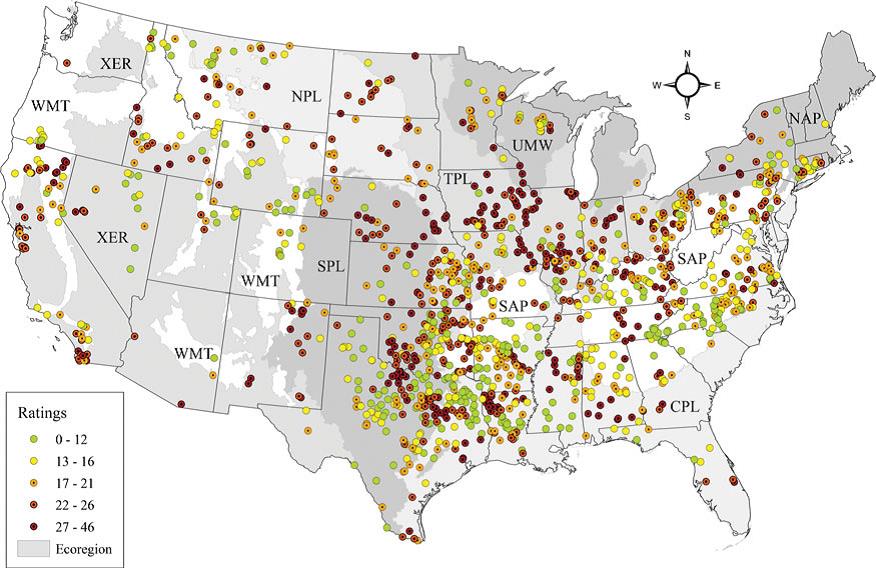
Figure 2. IRHI scores for 1,302 large U.S. reservoirs, based on 2010 Assessment.
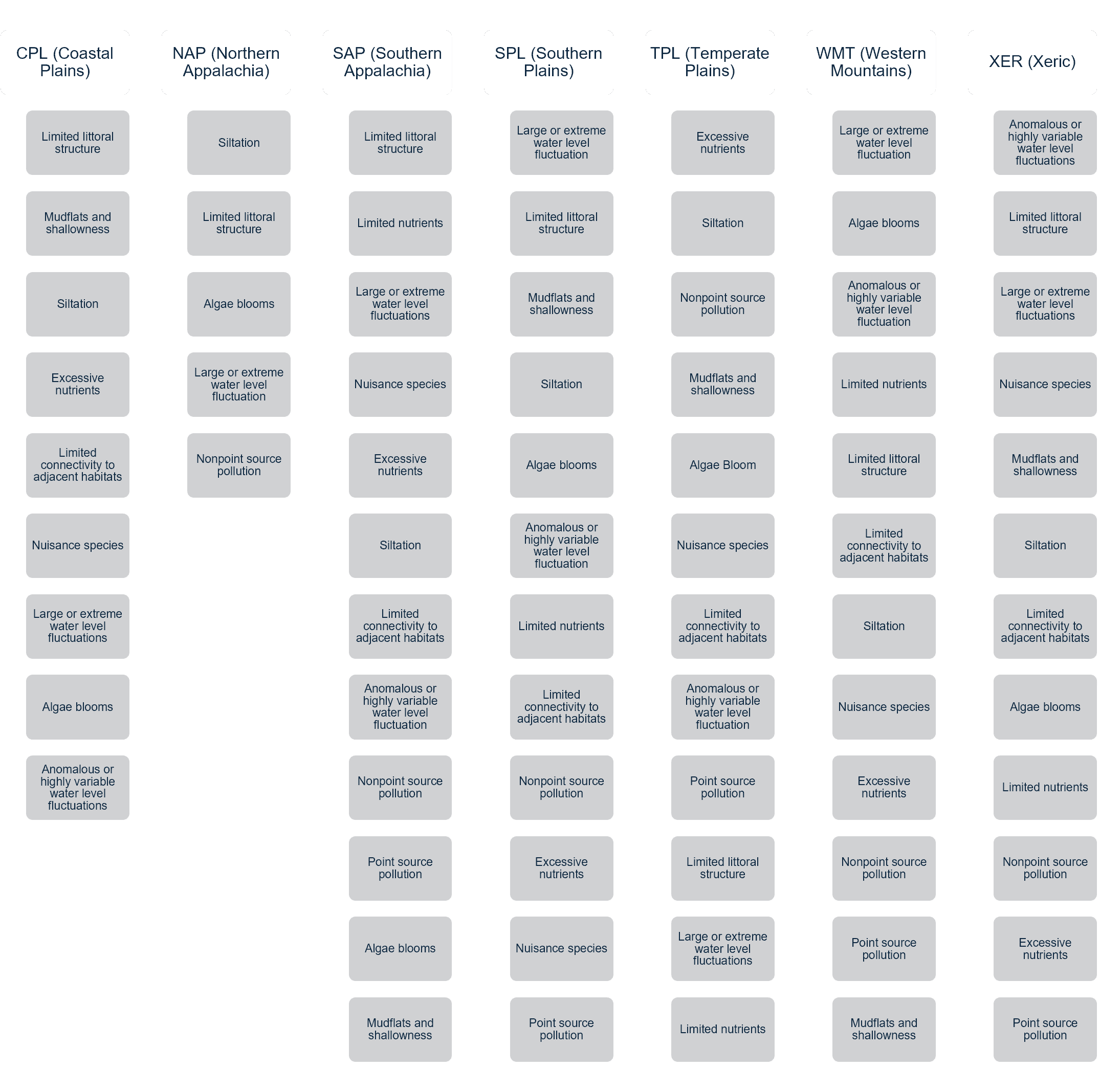
RFHP has been consolidating data by reservoir, state and region to be placed on the web and shared with partners. This work is on-going. Data gaps in the habitat impairment survey (largely related to low participation in certain regions [Xeric, Western Mountains, Upper Midwest and Northern Appalachians]) have been identified. Efforts are being made to expand the number of reservoir systems in these areas and new information is continually added to the database and reanalyzed. The regional priority impairments have been updated since the first analysis and new information is included in RFHP’s updated Project Selection Criteria. Regional priority impairments were used for the first time to prioritize project proposals for the FY2014 funding cycle and proposals addressing the priority impairments receive higher scores in the ranking system.
In 2024, regional impairment priorities were re-evaluated to ensure they aligned with current expertise and experience from the RFHP regional working groups. This yielded revised lists of impairment issues, which guide project scoring, as follows:
Priority Fish Species
The same nationwide survey of large reservoirs ≥ 250 acres yielded 1,250 responses which included fishery species information. For each reservoir surveyed, the first-, second- and third-most important recreational fish species were identified. These rankings were combined using the following formula:
where:

In this survey rank r ranges from 1 to 3 because survey respondents identified only the first, second, and third most important recreational species in each reservoir. The index range differs based on the ranges of input variables and yields a relative value meaningful to the nri locations and k species considered.
The following tables show a ranking of fish species by relative importance within each region. Again, the value of the index is only meaningful relative to the locations considered; that is, the values within each WSA region can be compared to create a ranked list of priority species. The values should not be compared between WSA regions.
Table 2. Priority species by region as established by the Reservoir Fisheries Habitat Partnership’s national assessment.
| Coastal Plains | Southern Plains | Temperate Plains | Southern Appalachians | Northern Appalachians | Northern Plains | Upper Midwest | Xeric | Western Mts. |
| Largemouth Bass | Largemouth bass | Largemouth bass | Largemouth bass | Largemouth bass | Walleye | Walleye | Largemouth bass | Trout spp. |
| Crappie spp. | Catfish spp. | Catfish spp. | Crappie spp. | Smallmouth bass | Trout spp. | Crappie spp. | Trout spp. | Largemouth bass |
| Catfish spp. | Walleye | Crappie spp. | Catfish spp. | Walleye | Esox spp. | Sunfish spp. | Catfish spp. | Smallmouth bass |
| Sunfish spp. | Crappie spp. | Sunfish spp. | Walleye | Crappie spp. | Smallmouth bass | Smallmouth bass | Walleye | Crappie spp. |
| Spotted bass | Morone spp. | Walleye | Sunfish spp. | Sunfish spp. | Crappie spp. | Largemouth bass | Smallmouth bass | Yellow Perch |
| Morone spp. | Sunfish spp. | Morone spp. | Smallmouth bass | Trout spp. | Largemouth bass | Esox spp. | Sunfish spp. | Catfish spp. |
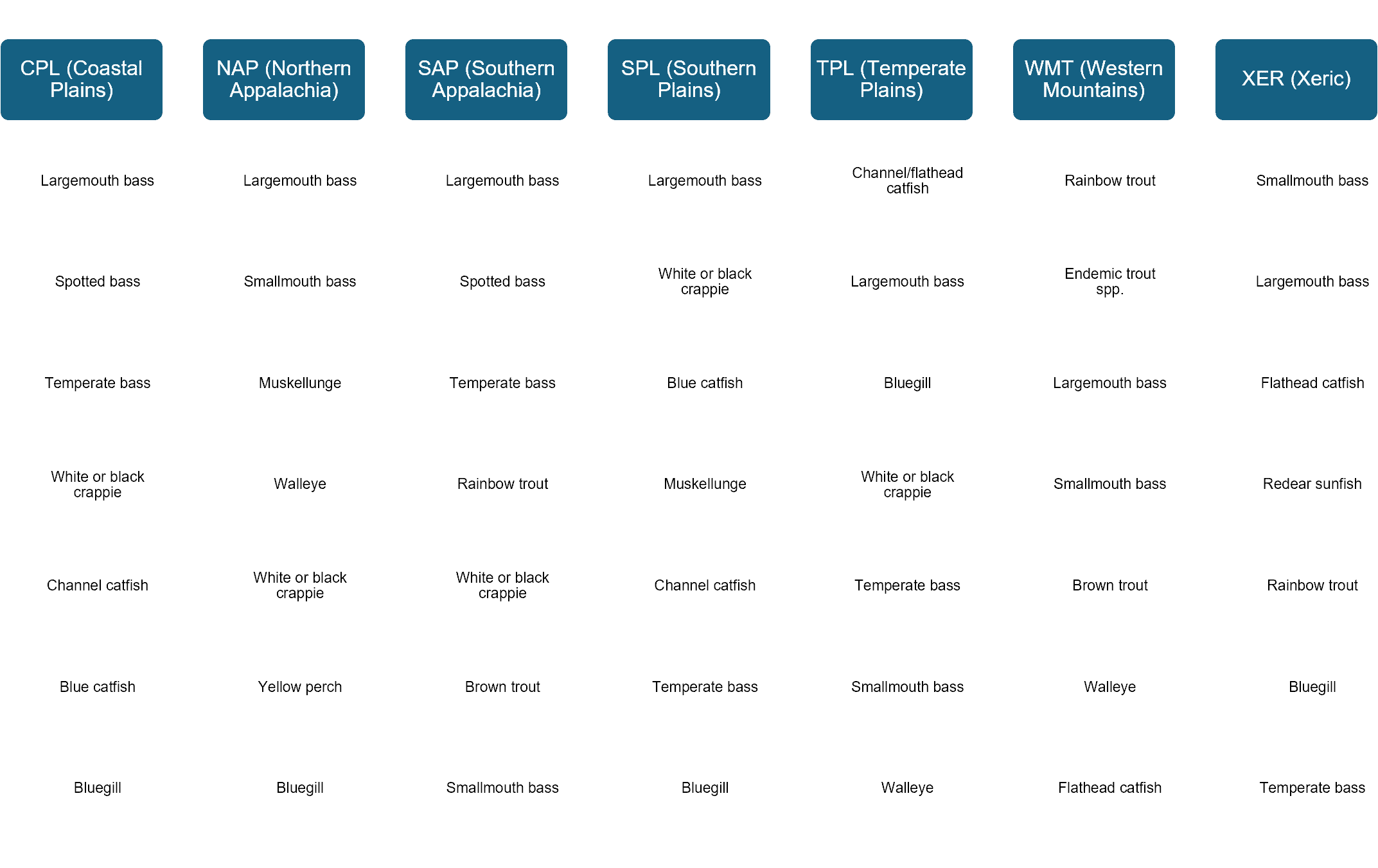
Again, these regionally-specific fishery priorities were reviewed in 2025 to ensure they still reflected recreational fisheries in reservoirs across their region. Using input from the RFHP regional working groups, the priorities were updated as:
Reservoir Metric Database
Many descriptors (measures) of surface-water reservoir basin features including physical, chemical, morphological, physiographic, hydrologic, and landscape characteristics are available that are likely to be related to reservoir eutrophication and impairment, reservoir fish habitat degradation, and invasive aquatic plant habitat infestation. USGS (Arkansas Water Science Center) was funded by FWS through the Reservoir Fisheries Habitat Partnership, to develop a Reservoir Metric Database (RMD) of surface-water reservoir measures and metrics for impounded water bodies greater than 250 acres across the 48 states. This database was updated in FY2015 and currently contains 114 measures and metrics for over 3,838 reservoirs across the 48 states. The use of geographical information systems (GIS), Microsoft Access and the statistical package JMP 10 aided in the RMD development. The RMD identifies reservoirs from the U.S. Army Corps of Engineers National Inventory of Dams (NID) joined with waterbodies from the USGS National Hydrography Dataset (NHD). Once the NID and the NHD were combined, they were intersected with the USGS Enhanced Riverreach File (ERF1_2). The intersecting of the ERF1_2 with the combined NID-NHD database enabled the connection of the USGS Spatially Referenced Regressions on Watershed attributes model and the completion of the RMD.
The database describes shape and form of individual reservoirs, within its watershed, as well as hydrologic measures. Information in the database can be used to estimate, for example, littoral zone size (shallow-water habitat) related to reservoir volume (index of reservoir permanence), shoreline development (measured reservoir shoreline distance relative to the circumference of a circle of the same surface area) and other metrics that can influence sediment and nutrient retention (eutrophication), fisheries habitat, invasive aquatic plant habitat infestation, and other functions and impairments. With the inclusion of watershed attributes from the various USGS major river basin SPARROW models, another 50 or more measures or characteristics related to each reservoir were included, like annualized nutrient loads and yields, sources and origins.
The RMD has been delivered to NFHP’s Science and Data Committee and discussions on inclusion of this information (along with the aforementioned reservoir habitat impairment information) in the national assessment are ongoing. Our goal is to have this information incorporated into the national assessment in FY2017.
A more detailed description of the Reservoir Habitat Impairment Assessment along with a state by state breakdown of the data are housed on www.friendsofreservoirs.org/science. Copies of manuscripts developed from the Assessment can be found on the same site. The Reservoir Metric Database is housed on www.friendsofreservoirs.org/science. The RMD has been published as a U.S. Geological Survey Technical Series entitled “A reservoir morphology database for the conterminous United States”; Data Series 1062. The report was authored by Kirk D. Rodgers.
Partnership Structure and Governance
Our partnership structure is made up of three parts:
- A national Steering Committee;
- Four Regional Workgroups (each corresponding to and associated with one of the four regional AFWA associations: the Northeast Association of Fish and Wildlife Agencies, the Southeast Association of Fish and Wildlife Agencies (represented by the Reservoir Committee of the Southern Division of the American Fisheries Society), the Midwest Association of Fish and Wildlife Agencies, and the Western Association of Fish and Wildlife Agencies;
- A Friends of Reservoirs national foundation with an affiliated network of local chapters.
The 15-member Steering Committee constitutes the governing structure of the partnership. Its role is to (1) implement the RFHP Strategic and Operational Plans; (2) set partnership policy; (3) establish national procedures and guidelines; (4) review and approve national conservation priorities; (4) request, acquire and allocate funds to projects; (5) provide oversight of and direction to Regional Workgroups, (6) conduct national assessments; (7) maintain a reservoir database coordinated with the NFHAP database; and (8) oversee monitoring and performance measurement and reporting. Three bodies serve the Executive Committee:
- Staff – a full-time paid coordinator (supported by voluntary staff from partnering agencies and organizations) who manages partnership operations and a part-time communications coordinator who manages digital communications, marketing, and social media efforts
- Science and Data Committee – RFHP volunteers who provide scientific consultation on implementation of the strategic plan, assessments, databases, and consistency with the NFHAP national strategic plan
- Outreach and Communication Committee – RFHP volunteers who support partnership development, advance public education, and address policy issues and needs
The Regional Workgroups are established by each of the four regional AFWA associations. They identify regional priorities, participate in development and selection of projects, and facilitate, monitor, and report project implementation. In addition, Regional Workgroups implement policies and strategic actions determined by the Executive Committee and support the Committee in implementation of the strategic plan, national assessments and databases, and periodic performance reporting. Although generally Regional Workgroups vote and score projects using only one representative per state agency, the RFHP welcomes all agency staff to participate in meetings and discussions.
Friends of Reservoirs (FOR: www.friendsofreservoirs.org) is the third arm of governance of the RFHP. Its purpose is to create an institutional base upon which to build and sustain the partnership in the long-term. It will engage the national constituency of reservoir stakeholders – those who rely on reservoirs and their watersheds for an array of ecological, economic, and recreational services – in the conservation of healthy reservoir systems through both a national foundation and an affiliated network of State and reservoir-level chapters. FOR will provide the participatory channels, volunteer force, and long-term support required by the partnership to meet its mission. It will create entry points into the everyday operations of the RFHP for both national and local supporters. In turn, it will provide to the RFHP direction in the setting of reservoir conservation priorities. FOR membership categories include Chapter (groups focusing on a single reservoir), Group/Organization (groups, corporations, etc. that do not have a single system focus but wish to support RFHP efforts at a state, regional and/or national level), and individual memberships for those wishing to support FOR with a monetary contribution.
FOR has a three-tiered membership program comprised of a) Chapter, b) Organizational or Group and c) Individual members. Chapter membership ($25 fee) is intended for entities that want to focus on a single reservoir, i.e., Friends of Lake X. Group membership ($100 fee) is for watershed, state-wide or region-wide groups that focus on larger geographic areas, i.e. a statewide conservation group such as Texas Black Bass Unlimited. Individual memberships ($25 fee) target individuals who simply want to contribute financially to reservoir habitat restoration with no particular body of water targeted. 100% of FOR memberships are designated for the FOR Small Grants Program that go into “on-the-ground” habitat restoration projects.
Become a Contributing Sponsor
Become a part of projects that need your support.